
📚 Well Testing for Beginners — Part 1 of 5
What Is Well Testing?
Well testing is the process of measuring how a well produces — or could produce — under controlled conditions. Engineers run tests to understand what is underground: how much fluid is there, how easily it flows, and what the reservoir pressure is.
Think of it like a medical check-up for a well. Just as a doctor measures your heart rate and blood pressure to understand your health, a petroleum engineer measures pressure and flow rate to understand the reservoir’s condition.
Why Do We Test Wells?
There are several reasons engineers perform well tests throughout a field’s life:
1. Determine Reservoir Properties
The two most important reservoir properties measured during a well test are permeability and skin factor.
Permeability measures how easily fluids flow through the rock. A high-permeability reservoir flows more easily and produces more oil or gas per day. Permeability is measured in millidarcies (mD). A good reservoir might have 100–500 mD, while a tight reservoir might have less than 1 mD.
Skin factor tells us whether the wellbore area is damaged or stimulated. A positive skin means the area near the well is damaged — perhaps by drilling mud invasion — which restricts flow. A negative skin means the well has been stimulated (for example, by fracturing) and flows better than expected.
2. Measure Reservoir Pressure
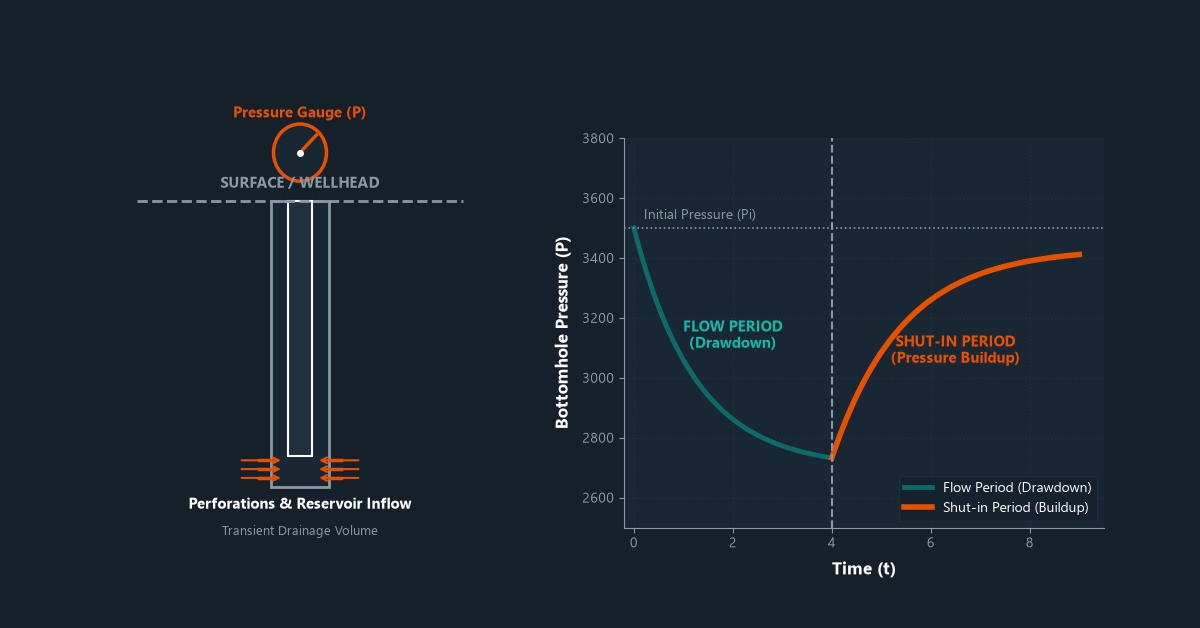
Reservoir pressure drives fluids toward the wellbore. During a well test, engineers shut in the well and watch how the pressure recovers. This tells them what the current average reservoir pressure is — critical information for planning production and deciding whether to inject water or gas to maintain pressure.
3. Evaluate Well Performance
A well test shows how much a well can produce under different conditions. This is called the deliverability of the well. For gas wells especially, engineers need to know the Absolute Open Flow (AOF) — the theoretical maximum rate if the wellbore pressure were reduced to zero.
4. Identify Reservoir Boundaries
When a well is tested for a long time, the pressure signal travels through the reservoir and can “hit” boundaries — faults, edges, or changes in rock type. By analyzing how the pressure behaves when it hits a boundary, engineers can estimate the size and shape of the reservoir.
The Main Types of Well Tests
There are several types of well tests, each designed to answer different questions:
| Test Type | What It Measures | When It’s Used |
|---|---|---|
| Pressure Buildup Test | Permeability, skin, average pressure | After production period |
| Drawdown Test | Permeability, skin, flow regimes | During first production |
| Drill Stem Test (DST) | Initial reservoir potential | Before completion |
| Deliverability Test | AOF, IPR curve | Gas wells |
| Interference Test | Connectivity between wells | Multi-well fields |
How Is a Well Test Conducted?
A typical well test follows these basic steps:
Step 1 — Flow Period: The well is opened and produced at a known rate. Pressure and rate are measured continuously using downhole gauges. Modern electronic gauges can record pressure changes as small as 0.001 psi every second.
Step 2 — Shut-in Period: The well is closed at the surface. Pressure builds back up. The rate and shape of this pressure buildup tell engineers about permeability and skin.
Step 3 — Data Analysis: Engineers plot the pressure data on specialized graphs and use equations from reservoir engineering to calculate reservoir properties. This is called pressure transient analysis (PTA).
What Equipment Is Used?
Well testing requires specialized equipment both at the surface and downhole:
Downhole gauges measure pressure and temperature inside the well. They are either permanent (installed in the completion) or temporarily run on wireline or tubing for the test.
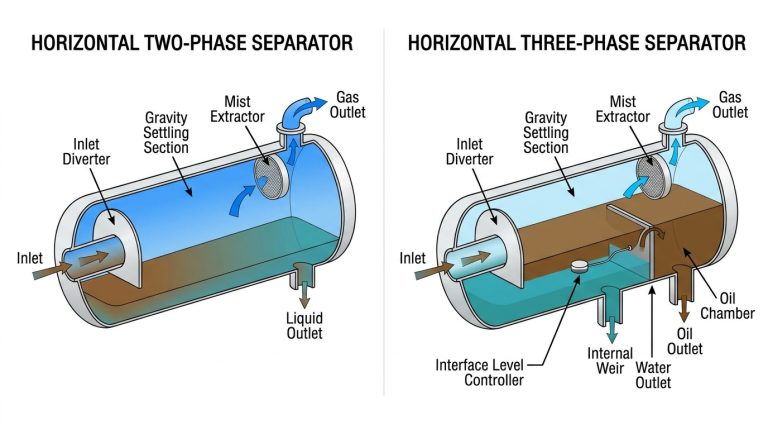
Surface test equipment includes a choke manifold (to control the flow rate), separators (to separate oil, gas, and water), and flare stacks (to safely burn off gas during the test). On offshore wells, all of this equipment is mounted on the platform deck.
Data acquisition systems record pressure, temperature, and flow rate in real time and transmit it to the surface for engineers to monitor.
Frequently Asked Questions
How long does a well test take?
It depends on the type of test and the reservoir. A simple pressure buildup test might take 24–72 hours. A full Drill Stem Test (DST) in an exploration well might run for 1–4 weeks. The test must be long enough for the pressure signal to travel far enough into the reservoir to give useful data.
Can you test a well that isn’t producing yet?
Yes. The Drill Stem Test (DST) is specifically designed for this — it tests the well while it is still in the drilling phase, before the final completion is installed. This tells the company whether the well is worth completing.
Is well testing the same as production testing?
Not exactly. Production testing is a routine measurement of daily flow rates and fluid composition. Well testing (pressure transient testing) is a more specialized analysis that uses pressure measurements to calculate reservoir properties. Both are important but serve different purposes.
Summary
Well testing is one of the most powerful tools petroleum engineers use to understand what is happening underground. By measuring how pressure changes when a well flows and when it shuts in, engineers can calculate permeability, skin factor, reservoir pressure, and boundaries — all without drilling another well.
In the next part of this series, we will look at the most common type of well test: the Pressure Buildup Test, and learn how engineers analyze the data it produces.
➡️ Next in this series: Pressure Buildup Test: How It Works
Leave a Reply