
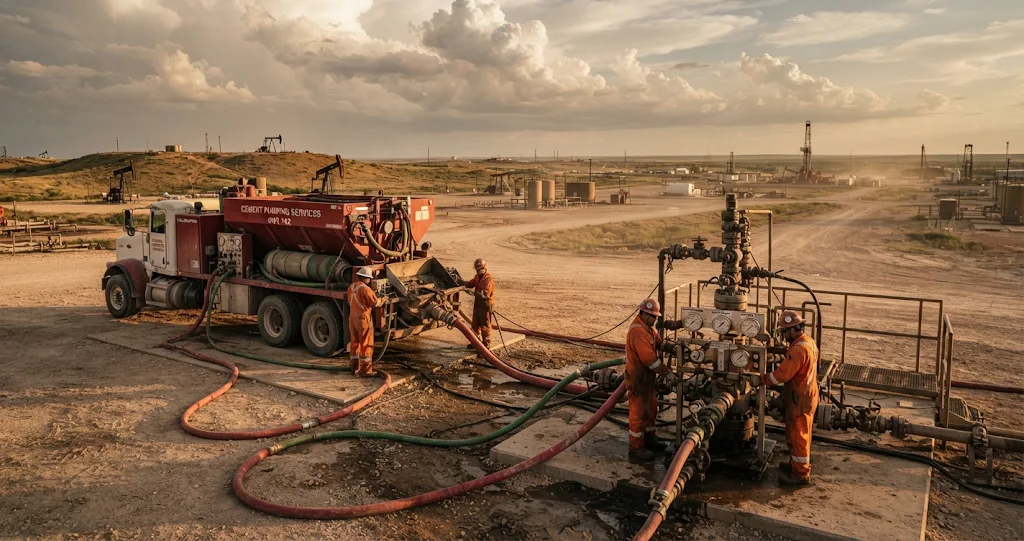
Well cementing is the process of mixing a slurry of cement and water, pumping it down the casing, and displacing it up into the annular space between the casing and the borehole wall, where it sets hard. The cement sheath seals the annulus, holds the casing in place, and prevents fluids from moving between formations. Without good cementing, even the best casing design cannot protect the wellbore.
Why Is Cementing Important?
Cement does several critical jobs in a well:
- Zonal isolation — it prevents oil, gas, water or drilling fluid from flowing between different formations along the annulus.
- Structural support — it bonds the casing to the formation and holds it against axial and lateral loads.
- Corrosion protection — it shields the outside of the casing from formation fluids that could corrode the steel.
- Well control — a good cement job helps contain formation pressures and reduces the risk of a blowout.
- Environmental protection — it seals off fresh water aquifers from deeper hydrocarbon-bearing zones.
The Two Main Types of Cementing
1. Primary Cementing
Primary cementing is the first and most important cement job. It is performed immediately after a casing string is run into the hole. The goal is to fill the annulus between the casing and the borehole with cement from the shoe (bottom of the casing) up to a planned height — called the top of cement (TOC). Surface and intermediate casing strings are normally cemented all the way back to surface. Production casing may be cemented only across the producing interval and a safety margin above it.
2. Remedial Cementing
Remedial cementing repairs or supplements an existing cement job that has failed or was never complete. The two most common techniques are:
- Squeeze cementing — cement slurry is forced under pressure through perforations or holes in the casing into the annulus or formation. It is used to repair channels in the original cement, shut off water production or repair leaking casing.
- Plug cementing — a balanced plug of cement is placed at a specific depth inside the casing. Plugs are used to abandon a zone, plug back to a shallower target, or provide a base from which to sidetrack the well.
How Primary Cementing Works: Step by Step
- Run the casing — the casing string is lowered into the drilled hole to its planned setting depth. Centralizers are placed along the string to keep it centred in the borehole; a casing that lies against one side of the hole will have a thin cement sheath on that side, which may not seal properly.
- Condition the mud — the drilling mud is circulated and treated to remove cuttings and reduce its gel strength, so it can be fully displaced by the cement.
- Mix and pump the cement slurry — cement is mixed with water (and additives) at surface and pumped down the inside of the casing. A bottom plug is pumped ahead of the slurry to wipe the casing clean and prevent mixing with the mud ahead.
- Displace the cement — a top plug is pumped behind the slurry, followed by displacement fluid (usually water or mud). The displacement fluid pushes the cement out through the casing shoe and up the annulus.
- Bump the plug — when the top plug lands on the float collar (a one-way valve near the shoe), the pump pressure rises sharply. This confirms that the designed volume of cement has been placed.
- Wait on cement (WOC) — the well is shut in and the cement is left to set. WOC time depends on the cement type and bottom-hole temperature, but is typically 8–24 hours before drilling resumes.
Cement Additives and Slurry Design
Plain Portland cement is rarely used alone. Engineers design the slurry to suit the well conditions by adding chemicals:
| Additive type | Purpose | Example |
|---|---|---|
| Accelerator | Shortens setting time in cold or shallow wells | Calcium chloride |
| Retarder | Delays setting time in deep, hot wells | Lignosulfonate |
| Extender | Reduces slurry density, lowers cost | Bentonite, pozzolan |
| Weighting agent | Increases slurry density for high-pressure wells | Barite, hematite |
| Fluid-loss additive | Reduces water loss to permeable formations | CMHEC, latex |
| Anti-gas migration | Prevents gas from channelling through unset cement | Latex, expanding agents |
Slurry density typically ranges from about 11 lb/gal (1.32 sg) for a lightweight extended slurry to 18 lb/gal (2.16 sg) for a heavy slurry in a high-pressure well.
Evaluating the Cement Job
After the cement sets, engineers run a cement bond log (CBL) to check the quality of the bond between the cement, casing and formation. The CBL uses acoustic signals: good cement attenuates the signal strongly, while a channel or void allows the signal to travel freely along the casing. A variable density log (VDL) gives additional detail on the formation bond. If the log shows a poor bond across a critical zone, a squeeze job may be needed.
Common Causes of Cement Job Failure
- Poor centralisation — casing lying against the borehole wall leaves a thin side where cement cannot flow.
- Mud channels — if the mud is not fully displaced, it leaves paths through which formation fluids can migrate.
- Gas migration — gas can enter the unset slurry and form channels before the cement develops strength.
- Incorrect slurry design — a slurry that sets too quickly in a hot deep well, or too slowly in a cold shallow well, may not give adequate isolation.
Frequently Asked Questions
How long does cement take to set in a well?
It depends on the cement type, additives and bottom-hole temperature. In a typical land well at moderate depth, the wait on cement (WOC) is 8–12 hours. In a cold offshore well, retarders slow setting, and WOC may be extended to 24 hours or more.
What is the difference between primary and squeeze cementing?
Primary cementing is done when the casing is first run, to fill the annulus with cement. Squeeze cementing is a repair operation performed after the well is drilled, forcing cement under pressure into voids or channels left by a failed primary job.
Why are centralizers used?
Centralizers keep the casing in the centre of the borehole so that the annular gap is even all around. An even gap ensures that cement can displace mud uniformly and form a complete sheath with no thin spots.
What is a float collar?
A float collar is a one-way valve placed one or two joints above the casing shoe. It prevents cement from flowing back up into the casing after pumping stops, and it is where the top plug lands to signal the end of displacement.
Key Takeaways
- Cementing fills the annulus between the casing and the borehole to isolate zones, support the casing and protect fresh water.
- Primary cementing is performed when each casing string is run; remedial cementing repairs a failed job.
- Centralizers, correct slurry design and full mud displacement are the keys to a good cement job.
- The cement bond log (CBL) is used to evaluate whether the cement has properly bonded to the casing and the formation.
Cementing is closely linked to casing design and to well planning.



Leave a Reply