
Part 10 of 10 in the series From Reservoir to Surface: Oil and Gas Production for Beginners. Previous part: Oil and Gas Separators.
Oil well production problems are conditions that reduce a well’s rate, damage equipment or make production unsafe or uneconomic. The four most common are sand production, excessive water, scale and gas hydrates, often joined by wax, asphaltenes and corrosion. Most of them can be prevented or managed if they are recognised early.
1. Sand Production
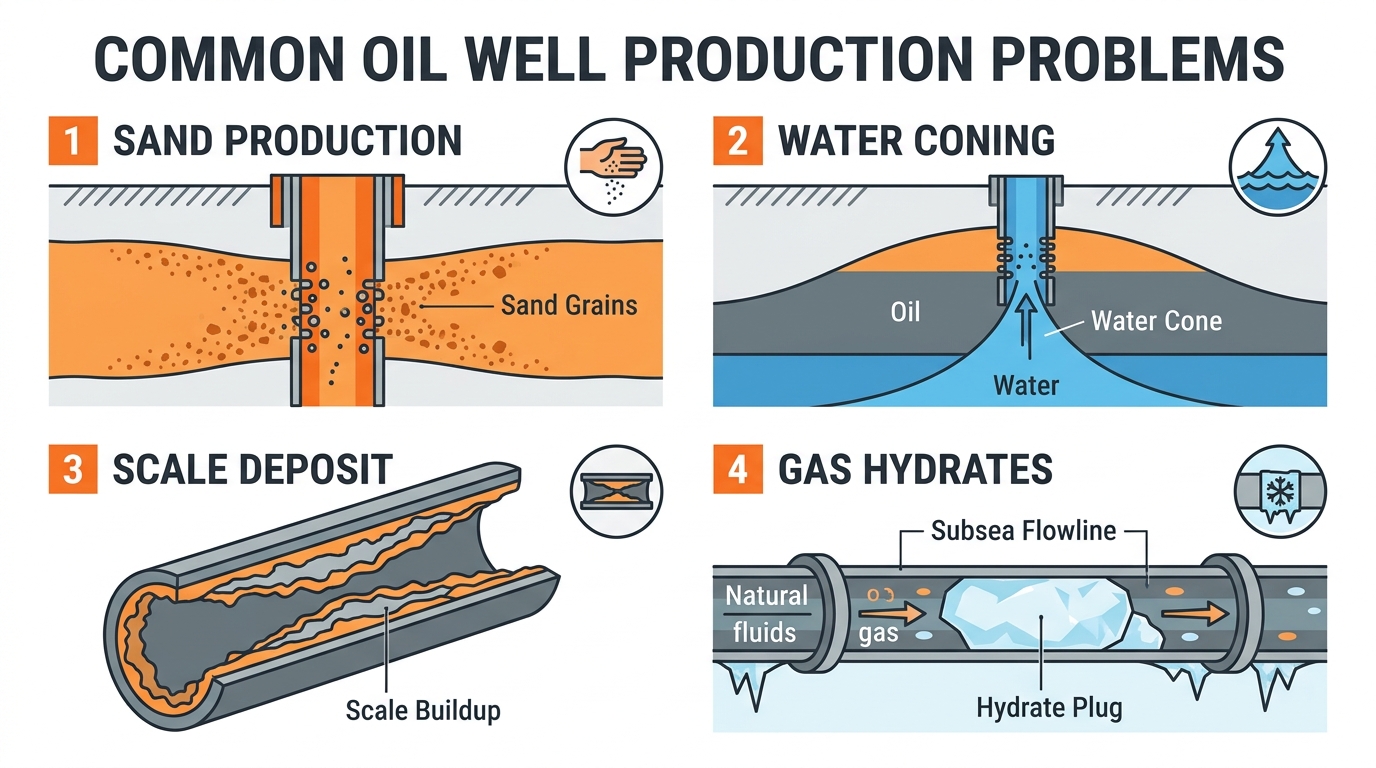
Sand production happens when grains break loose from a weak reservoir rock and travel with the fluid into the well.
Causes
- Weak or poorly cemented sandstone, often in young, shallow formations.
- High drawdown and high flow velocity near the wellbore.
- Falling reservoir pressure, which increases the stress on the rock.
- Water breakthrough, which can dissolve or weaken the natural cement between grains.
Effects
- Erosion of chokes, valves, tubing and flowlines.
- Sand filling the bottom of the well and covering perforations.
- Sand settling in separators and tanks.
- In severe cases, collapse of the formation or the casing.
Solutions
- Limiting drawdown and rate to stay below the sanding limit.
- Mechanical sand control: screens, gravel packs and frac packs (see Types of Well Completion).
- Oriented or selective perforating to avoid the weakest intervals.
- Chemical consolidation, which binds grains with resin.
- Surface sand management: detectors, desanders and sand jetting in vessels.
2. Excessive Water Production
Almost every oil reservoir contains water. As a field matures, the water cut rises. Too much water makes the fluid column heavier, adds treatment and disposal cost and can kill a naturally flowing well.
Causes
- Water coning: in a vertical well above a water zone, the pressure drop pulls water upward in a cone shape into the perforations.
- Edge water encroachment or early breakthrough of injected water through high-permeability layers.
- Mechanical problems: casing leaks or poor cement allowing water from another zone to flow behind the pipe.
Solutions
- Reducing the rate to stay below the critical coning rate.
- Perforating high in the oil zone, away from the water contact.
- Isolating watered-out zones with cement squeezes, plugs or packers.
- Gel or polymer treatments to block water paths.
- Production logging to find where water enters.
3. Scale
Scale is a hard mineral deposit that forms when dissolved salts in produced water come out of solution. It builds up in perforations, tubing, valves and surface equipment and restricts flow.
Common types
- Calcium carbonate (CaCO3): forms when pressure drops and CO2 leaves the water, or when temperature rises. It dissolves in hydrochloric acid.
- Barium sulphate (BaSO4, barite): forms when sulphate-rich seawater used for injection mixes with formation water containing barium. According to the Heriot-Watt Production Technology course, its solubility is only about 4% of that of calcium carbonate, which makes it very hard to remove.
- Strontium sulphate (SrSO4) and calcium sulphate (CaSO4, gypsum): less common, but found in some fields.
Solutions
- Scale inhibitors: chemicals that delay crystal growth even at low concentration. They are injected continuously or squeezed into the formation.
- Acid washes for carbonate scale.
- Mechanical removal: milling or jetting with coiled tubing for hard sulphate scale.
- Water management: removing sulphate from injection water where barium is present.
4. Gas Hydrates
Gas hydrates are ice-like solids in which water molecules trap small gas molecules such as methane. They can block tubing, chokes, flowlines and gas lift injection lines. The book Natural Gas Hydrates (Carroll) lists three conditions needed for hydrates to form:
- The right combination of low temperature and high pressure.
- A hydrate former, such as methane, ethane or carbon dioxide.
- Enough water.
Where hydrates form
Typical places are across chokes, where gas expansion causes cooling, in subsea and cold-climate flowlines, and during start-up after a shutdown.
Solutions
- Removing water by gas dehydration with glycol.
- Keeping temperature above the hydrate point with insulation or heating.
- Injecting thermodynamic inhibitors such as methanol or monoethylene glycol (MEG).
- Low-dosage kinetic and anti-agglomerant inhibitors.
- Reducing pressure carefully to dissolve a hydrate plug. This must be done on both sides of the plug, because a plug released under pressure can move like a projectile.
Other Common Problems
- Wax (paraffin): deposits when crude cools below its wax appearance temperature. Managed with heat, scraping (pigging) and inhibitors.
- Asphaltenes: heavy compounds that drop out with pressure changes. Treated with solvents.
- Corrosion: caused by CO2, H2S, oxygen and water. Managed with corrosion-resistant alloys, inhibitors and monitoring.
- Formation damage: fines migration, emulsions or mud invasion near the wellbore, seen as a high skin factor.
- Liquid loading in gas wells: liquids that the gas can no longer lift collect in the well and reduce its rate.
How Engineers Detect Problems Early
- Trending rates, water cut and wellhead pressure for sudden changes.
- Regular well tests and well performance evaluation.
- Water analysis to predict scale tendency.
- Sand detectors and erosion probes on surface lines.
- Production logging and bottom hole pressure surveys.
Frequently Asked Questions
What is the most common production problem in oil wells?
It depends on the field, but increasing water production affects almost every mature oil field. Sand is the main concern in weak sandstones, and scale in fields under seawater injection.
How is calcium carbonate scale removed?
It dissolves in hydrochloric acid, so acid washes are the usual treatment. Sulphate scales do not dissolve in acid and are usually removed mechanically.
Why do hydrates form at chokes?
Gas cools as it expands across the choke. The temperature can drop into the hydrate zone while the pressure upstream is still high.
Conclusion
Sand, water, scale and hydrates are the problems production engineers deal with most often. Each one has clear causes and proven solutions, and early detection through monitoring is the best defence. This article closes our series From Reservoir to Surface. You now have a beginner’s map of the whole production system, from the reservoir to the separator.
Start the series from the beginning: Part 1, The Oil and Gas Production Process.
Leave a Reply