
📚 Reservoir Engineering Fundamentals — Part 1 of 5
What Is Reservoir Engineering?
Reservoir engineering is the branch of petroleum engineering that studies how oil and gas reservoirs behave — how fluids are stored underground, how they flow toward producing wells, and how much can ultimately be recovered. It sits at the heart of every oil and gas project, connecting the geological description of a reservoir to the production numbers that determine whether a field is profitable.
Think of a reservoir engineer as the person who answers the two most important questions in the oil business: How much is in there? and How much can we get out? To start understanding reservoirs, it helps to first read about what petroleum is and the oil and gas production process from reservoir to surface.
What Does a Reservoir Engineer Do?
Reservoir engineers work throughout the entire life of a field — from appraisal to abandonment. Their key responsibilities include:
Estimating reserves: Calculating how much oil and gas is in the reservoir (original oil in place, OOIP) and how much can be economically recovered (recoverable reserves). These numbers drive investment decisions worth billions of dollars. See reserves classification for how industry standards categorize these volumes.
Predicting production: Building models that forecast how production rates will change over time — the production profile. Banks and investors rely on these forecasts when financing oil field development.
Optimizing recovery: Deciding how many wells to drill, where to place them, how fast to produce, and whether to implement enhanced oil recovery (EOR) methods to extract more than primary production would allow. Waterflooding is one of the most common secondary recovery methods.
Monitoring reservoir performance: Comparing actual production data with predictions to identify problems — pressure depletion, water breakthrough, gas coning — and adjust the development plan accordingly. Tools like well testing provide real-time reservoir data for this monitoring.
The Reservoir: What Is It?
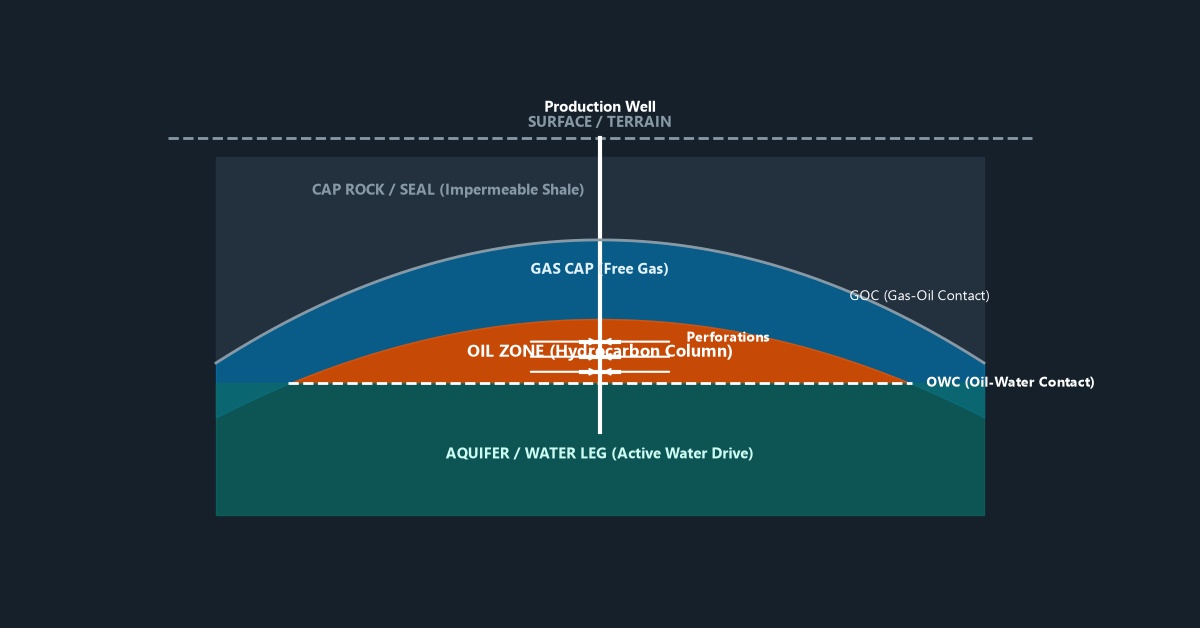
A petroleum reservoir is a porous and permeable rock formation underground that contains oil, gas, or both, sealed by an impermeable cap rock that prevents the fluids from escaping upward. The most common reservoir rocks are sandstone and carbonate (limestone or dolomite). Read more in Reservoir Rocks: Types and Properties.
Three key properties define a reservoir rock:
Porosity (φ): The fraction of the rock volume that consists of pore spaces — the voids that hold the oil, gas, and water. A typical reservoir rock has 10–30% porosity. Higher porosity means more storage space. Porosity is measured as a decimal or percentage: φ = 0.20 means 20% of the rock volume is pore space. See porosity explained for details.
Permeability (k): How easily fluids can flow through the connected pore spaces. Measured in millidarcies (mD). High permeability (100+ mD) allows fast flow; low permeability (less than 1 mD) makes production difficult and expensive. See permeability explained.
Fluid saturation: The fraction of pore space occupied by each fluid — oil, gas, and water. Saturation values always add up to 1.0 (or 100%). If a reservoir has 65% oil saturation (So = 0.65), that means 65% of the pore space contains oil, with the rest holding water (and perhaps some gas). Learn more about classification of reservoir fluids.
Original Oil in Place (OOIP)
The Original Oil in Place (OOIP) is the total volume of oil in the reservoir before any production begins. It is calculated using the volumetric method:
OOIP = (A × h × φ × (1 − Swi)) / Boi
Where A is the reservoir area, h is the net pay thickness, φ is porosity, Swi is the initial water saturation (the water always present in pores even in an oil reservoir), and Boi is the initial oil formation volume factor (which converts reservoir barrels to stock tank barrels at surface conditions).
Not all of the OOIP can be produced. The recovery factor (RF) is the fraction that can be economically extracted. Primary recovery typically achieves 10–30% RF; secondary recovery (waterflooding) can push it to 30–50%; tertiary methods (EOR) can recover even more. See Recovery Factor for the full analysis.
The Material Balance Concept
One of the most fundamental principles in reservoir engineering is material balance: the fluids produced from a reservoir must equal the fluids that expand (or enter) to fill the space they left behind. This is simply a conservation of mass applied to the reservoir.
The material balance equation (developed by Havlena and Odeh) is a powerful tool for estimating OOIP and understanding what energy is driving production. We will cover it in detail in Part 2 of this series. Understanding formation pressure is essential before applying material balance methods.
Frequently Asked Questions
How is reservoir engineering different from production engineering?
Reservoir engineering focuses on what happens inside the formation — how fluids flow through rock, how reservoir pressure behaves, and how much can be recovered. Production engineering focuses on the well itself — the tubing, completion, artificial lift, and surface equipment needed to bring fluids to the surface efficiently. The two disciplines work closely together. See types of artificial lift for the production engineering side.
What software do reservoir engineers use?
The most common reservoir simulation software includes Eclipse (Schlumberger/SLB), CMG (Computer Modelling Group), and tNavigator (Rock Flow Dynamics). For material balance calculations, MBAL from Petroleum Experts is widely used. For decline curve analysis, tools like Fekete Harmony or Spotfire are common.
Summary
Reservoir engineering is the science of understanding oil and gas reservoirs — estimating how much is there, predicting how much can be produced, and optimizing the recovery process. The three fundamental rock properties — porosity, permeability, and fluid saturation — are the building blocks of every reservoir analysis. The OOIP calculation and the material balance concept sit at the core of the discipline.
In Part 2, we will explore the material balance equation in detail — the reservoir engineer’s most powerful analytical tool for understanding reservoir energy and estimating oil in place.
➡️ Next in this series: Material Balance: The Reservoir Engineer’s Accounting Tool


Leave a Reply