
📚 Well Testing for Beginners — Part 4 of 5
What Is a Drill Stem Test (DST)?
A Drill Stem Test (DST) is a temporary well test performed while the drill string is still in the hole, before the well is cased and completed. It is the first real look at what a reservoir can produce and how it will behave. Engineers use DSTs to decide whether a well is worth completing commercially.
If you are new to well testing, read What Is Well Testing? first for the broader context.
Why Perform a DST?
After drilling through a promising formation, operators want answers before spending money on casing and completion. A DST provides:
- Confirmation that the formation actually contains producible hydrocarbons
- Measurements of initial reservoir pressure
- Estimates of permeability and skin (formation damage)
- Fluid samples for laboratory analysis (PVT data)
- Flow rates achievable from this formation
The formation pressure measured during a DST is one of the most important values in reservoir engineering.
DST Equipment and Setup
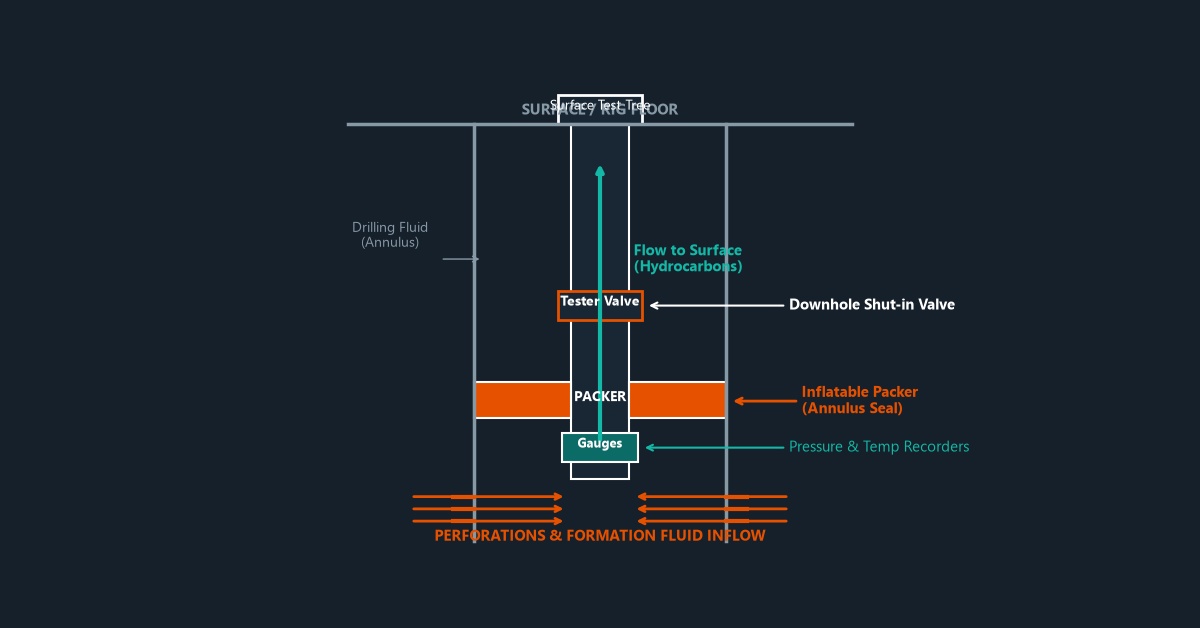
The DST string runs inside the drill pipe and includes several key tools:
- Packer: An inflatable or mechanical device that isolates the test zone from the rest of the wellbore. The packer is set above the formation to be tested, so only that zone communicates with the surface. Learn more about downhole completion tools including packers.
- Downhole gauges: Pressure and temperature sensors that record data throughout the test.
- Drill stem tester valve: Controls whether the formation is open or closed to flow.
- Perforating guns (if cased): In a cased-hole DST, guns shoot holes through the casing to allow flow.
The DST Sequence
A standard DST follows a repeating open-shut pattern:
- Initial shut-in period (ISIP): The formation is closed. Pressure builds to the initial reservoir pressure. This baseline reading is critical.
- First flow period (FFP): The well is opened and formation fluid flows to surface or into the drill pipe. Duration is typically 15–60 minutes.
- First shut-in period (FSIP): The well is closed again. Pressure builds back up. A short buildup test is performed.
- Second flow period (SFP): A longer flow period that provides stabilized flow data.
- Final shut-in period (FSIP): The longest buildup period. This is the most valuable for calculating permeability and skin using the same analysis methods as a pressure buildup test.
What Does DST Data Tell Us?
From the pressure record, engineers extract:
- Initial reservoir pressure (Pi): The undisturbed pressure in the formation before any production.
- Permeability (k): How easily fluid flows through the rock. See permeability explained for the basics.
- Skin factor (S): A measure of near-wellbore damage or stimulation. See skin factor for details.
- Productivity index (PI): How many barrels per day the well produces per psi of drawdown.
Open-Hole vs. Cased-Hole DST
An open-hole DST is run before casing is set. The packer isolates the bare formation directly. This is the most common type in exploration wells.
A cased-hole DST is run after casing but before permanent completion. Perforating guns open windows in the casing to allow flow. This is more common in development wells where specific zones need to be tested individually. Learn about perforation in oil wells.
Safety Considerations
A DST brings live formation fluids to surface for the first time. This requires:
- A properly rigged-up surface test package (flare, separator, tanks)
- Blowout preventer (BOP) fully operational
- Monitoring for unexpected pressure surges or kicks
Understanding well kicks and well control is essential for anyone involved in a DST.
Frequently Asked Questions
How long does a DST take?
A typical DST lasts 12 to 72 hours depending on the formation and the information needed. Very tight reservoirs (low permeability) need longer shut-in times for pressure to stabilize.
Can a DST damage the formation?
If flow rates are too high, the pressure drawdown can cause sand production or formation collapse near the wellbore. Engineers control flow rates carefully and monitor for sand. High skin factors after a DST may indicate this type of damage.
Summary
The DST is the most direct way to evaluate a reservoir before committing to full completion. It combines flow testing and pressure buildup analysis to deliver formation pressure, permeability, skin, and fluid samples — all while the drill string is still in the hole. The data from a DST directly informs the completion design and production forecast for the well.
Next in this series: Gas Well Deliverability Testing and AOF curves.
➡️ Next in this series: Gas Well Deliverability Testing: AOF and IPR Curves


Leave a Reply